Leaving War-Torn Le Havre

His whole life my dad hated standing in lines. He wouldn’t do it at Disneyworld, not at a cafeteria, not at a movie theater. In looking at this index of his photos from the time he and his buddies were readying to leave the war continent, they didn’t accomplish much or move very far in this week-plus of time. They deserved a break, for sure, but knowing what awaited them on the other side of the ocean must have been an agonizing delay. The open ocean ahead and the destroyed city in the rearview mirror is a perfect memory of that time. (See Le Havre today here and here.)

Coastline at Le Havre.

Bernard McKenzie, June 27, 1945

The coastline at Le Havre, France.

Bernard McKenzie, June 27, 1945

A U.S. barge carrying army rations. Le Havre coastline in background.

Bernard McKenzie, June 27, 1945

A harbor view of war torn Le Havre, France.

Bernard McKenzie, June 27, 1945

Heading Home, Finally

I can’t even begin to imagine what must have been going through my dad’s mind at the end of June, 1945. While I’m still working to uncover details about when and from where my father, Bernard McKenzie, was finally released from the German POW camp, it’s safe to assume that he and thousands of other American heroes had been working their way toward the French coast for about two months. I’m sure there was a European continent-wide exhale on VE Day–May 8, 1945–but to the American troops it was just the beginning of a very long journey home. Compared to the days prior to Germany’s unconditional surrender, this march across the continent was met by cheering locals just returning home and children who wanted to catch a glimpse of their rescue heroes, who often also had fistfuls of candy for them. Today you could walk from Germany, through Luxembourg, into Belgium, and end in Le Havre without much difficulty–especially when compared to the Army issue boots and heavy gear the infantrymen carried–but the journey would cover over 400 miles and take more than 150 hours.

A view of the Star Board side of our ship, the Marine Dragon. Taken on the high seas. Enroute to U.S.A.

Bernard McKenzie, June 30, 1945


Nothing but water. The Atlantic Ocean. Taken on the high seas.

Bernard McKenzie, June 30, 1945


Beau Cou water. The Atlantic. Enroute to the U.S.A.

Bernard McKenzie, June 30, 1945

Heading Home, Finally

After nearly 7 months in Europe representing America and the Free World (he went there to fight, really, or at least to help care for those who did and got injured; but he ended up getting shot himself, got disoriented behind enemy lines in the Ardennes during the Battle of the Bulge, and was a POW for the rest of the war), Bernard McKenzie was headed home.

A view of our Marine Dragon. Taken aboard ship. Notice the two 50 cal machine guns.

Bernard McKenzie, somewhere in the English Channel, July 1, 1945


From his stories and from these photos, my dad made dozens of lifetime friends and acquaintances. Even if they never saw each other again after Europe, their connections were remarkable, memorable, forever. For information on the SS Marine Dragon and other C-4 ships go to http://www.usmm.org/c4ships.html.

Merrill Baker. Taken aboard the Marine Dragon. Enroute to U.S.A.

Bernard McKenzie, July, 1945

WW2 Cigarette Camp, Camp Home Run

During the early stages of the American European offensive, “cigarette camps” sprung up as staging areas for American troops about to engage in battle. After the German surrender, the camps took on a new life as as disembarkation staging areas for GIs waiting to sail across the Atlantic to head back home. The camps were named after cigarette brands to help conceal their location from the Germans, and actual cigarettes were plentiful, which was welcomed by many GIs.

One such camp was Camp Home Run, located just outside Le Havre, France in the town of Sanvic. After his release as a POW, my father Bernard McKenzie called Home Run home for about a week at the end of June, 1945. Learn more about the cigarette camps and Camp Home Run here.

A view of Camp Home Run. Notice the German forts surrounding the camp.

Bernard McKenzie, Le Havre, France, June 26, 1945


A Short Time Spent at Camp Home Run, Le Havre, France, June 1945


Once a German fort, Camp Home Run was a restful place for American GI’s awaiting shipment home.

Bernard McKenzie, Le Havre, France, June 23, 1945

In his last stop in Europe after being freed from a German POW camp, my dad and many others spent about a week at Camp Home Run in Le Havre, France.

Underground tunnel barracks that we were housed in during our 5 days at Home Run.

Bernard McKenzie, Le Havre, France, June 23, 1945

A flag raising ceremony at Camp Home Run.

Bernard McKenzie, Le Havre, France, June 24, 1945

Here we could write letters, play cards, checkers, ping pong, read, etc.

Bernard McKenzie, Le Havre, France, June 24, 1945

At Camp Home Run–near Le Havre, France–we had all the service one would want. French girls served us in a cafeteria manner.

Bernard McKenzie, Le Havre, France, June 24, 1945

Service deluxe was to be had at Camp Home Run. These are a few French girls who dished out food in the kitchen.

Bernard McKenzie, Le Havre, France, June 23, 1945

We had stayed at “Home Run” for 5 days. We were sweating out boarding our ship. Here we are leaving “Home Run”–boarding trucks and en route to our boat.

Bernard McKenzie, Le Havre, France, June 26, 1945

By just looking at the calendar, my dad’s time in Europe was only a little more than six months. But the events of the short time he was there cover more than one full chapter in a history textbook. He landed in France and moved with his infantry division north through France into Belgium, to help protect the Allies eastern front in the Ardennes. Little did he know that just after Christmas, he and thousands of other Americans would be captured in one of Germany’s largest, final offenses, in what would become known as the Battle of the Bulge. After nearly six months of captivity, my dad and others like him must have so welcomed settling down to sleep in a place named Home Run before getting on a ship for the long journey home.

Bernard McKenzie, U.S. Army, World War 2

Chuck and I near Schleiz, Germany.

Bernard McKenzie, June 1945

That’s my dad on the right, at 25 years old. His resemblance to my son Ben is striking.

I’m trying to organize these photos to represent both a timeline and his travels along a map through Germany and France. For 30 years I’ve wanted to share these photos with the world, and I actually think what I’m going to learn for myself will also be of extraordinary consequence.

A Preview of My Dad’s Past, Through His Eyes and Words


German PW’s are completing work on a volley ball court. Soon after they finished we played a game.

Bernard McKenzie, June 24, 1945

With a camera and a pen, my dad recorded for all of us many of his experiences and thoughts while in Europe during World War 2. With nearly 200 photos, many of which have incredible descriptions inked on the back, my dad left me a bit of a puzzle. While I have a pretty good idea of my dad’s story–including the six-month interruption in these photos caused by his internment by the Germans–spending the time to focus on these photos and inscriptions while I publish them here will surely help me fill in some of the blanks. I plan to tell the story of this enlisted member of the Army’s 87th Infantry Division, the Golden Acorns. And in doing so, I want to share his story told by these amazing mementos with the world.


Super Bowl LI

50800682012__93f4f697-cab7-4267-942f-9b1e373f3cfd

The 2001 NFL season is one I remember most vividly. I had a feeling throughout the season that not only were we in New England getting the opportunity to witness the emergence of an unknown phenom-to-be in Tom Brady, but I also felt like we were able to understand and value an evolution the game was undergoing that valued toughness, intelligence, and team-first play unlike ever before. Time and again I witnessed the Patriots not only best the point spread, but we also saw them win game after game in the regular season and playoffs in which former players, coaches, and supposed experts picked them to lose outright. In these earliest decades of the Internet in which we live, it shocked me every week that somehow the “secret” that was building momentum in Foxboro wasn’t picked up on by anyone outside of New England. By the time they got ready to kick off the Super Bowl agains the Rams, many of us just knew the Pats could win or even would win, while the experts had them as a 2-touchdown underdog.

As I sit here writing this, it’s 3 hours and 12 minutes from the kick off of Super Bowl LI, and it’s starting to feel like deja vu all over again. Sure, the Pats are favored to win by the spread (3 points), and fivethirtyeight.com suggests they have a 61% chance of beating the Falcons. But that’s all? 3 points versus a 5-loss team with only 4 players with Super Bowl experience? Matt Ryan–not Tom Brady–wins both the MVP and Offensive Player of the Year? Atlanta has 3 All Pro players, while the Pats have 1? (only Matt Slater was selected, for Special Teams) Kyle Shanahan–and not Matt Patricia, Dante Scarnecchia, or Josh McDaniels–wins assistant coach of the year? The 5 win Falcons? The freaking 5- win Falcons. 16 years into the Belichick-Brady era, the finest run in any professional sport since Auerbach and Russell, and everybody outside of New England is still underestimating this team. Just this season, the Patriots are 13-3 against the spread. By now, wouldn’t you think they’d be over-rated? That is, even at 14-2, I would think the oddsmakers and everyone else would have been burned so many times over the years that they would “over-favor” the Pats at every turn. But they haven’t, and even though I haven’t bet on these games and gotten rich, it still gives me tremendous joy and satisfaction to watch hard work, toughness, and competitive intelligence pay off and lead to victories. And it will again tonight as well. Patriots 34, Atlanta 16. Maybe one day they all will learn.

Hannah Starting School on UD Campus

blue-hen img_2455

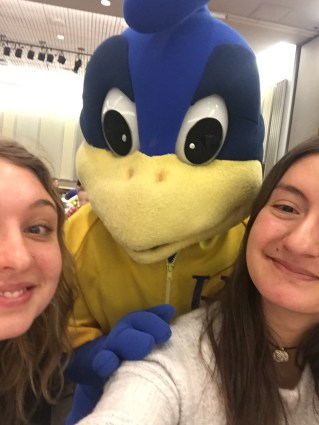
Laura and I moved Hannah into her dorm on campus at UD Thursday night. Move in and orientation coincides with the end of the January term, but the number of students on campus is small. Everyone else who didn’t attend January term will be back in Newark this weekend.

Hannah’s room is on the 5th floor of Gilbert Hall. One of her roommates, Marissa, has been on campus during January term, and the other will return soon. Kristy and Mikaela from World Scholars are also on Hannah’s floor, and many of her other WS friends are in dorms nearby.

We met them all yesterday for a coffee before attending the opening session of Spring term New Student Orientation. Including parents, there were probably 500 people in attendance. The university president provided opening remarks, and it struck me as fitting  for these xenophobic times that the president of a major regional East Coast research university hails from Greece. In Hannah’s less than 10 month affiliation with UD, I’ve already found myself proud of the university, its people, its programs, and its decisions and voice more than a dozen times.

I probably immerse myself more than I should in all of the decisions around meal plans, housing, clubs and teams, and classes to help ensure that while Hannah may be far away in distance, she stays nearby in heart and soul. I also happen to be pretty good at sifting through the minutiae, and I have the patience for it and the ability to make rational decisions. I know my over eagerness drives Hannah crazy, but she also appreciates that I care as much as I do. I couldn’t be more proud of her and all that I know she’s going to do in her life.

A Meeting with President Truman, April 1948

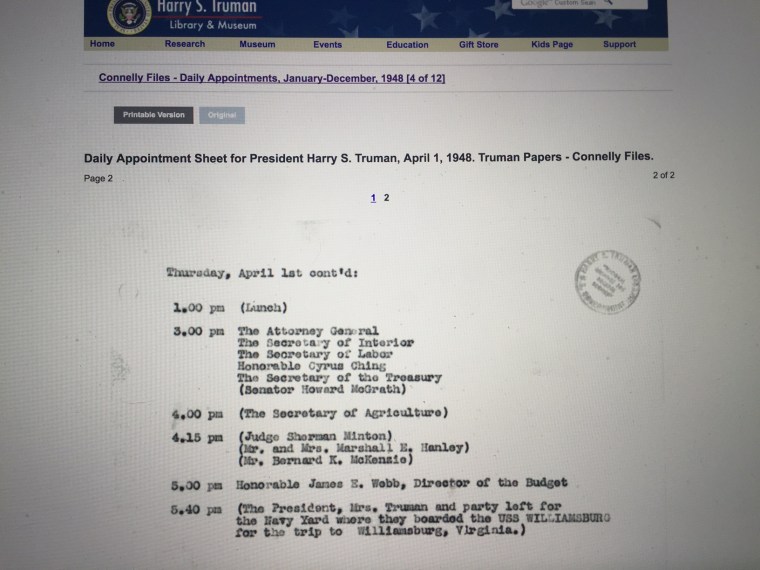
img_2438On April 1, 1948, my father Bernard McKenzie, his best friend Marshall Hanley, and Marshall’s wife accompanied Hanley’s family friend Sherman Minton to meet with President Harry S. Truman at the White House. Less than 18 months later, Truman tapped Minton to become the newest member of the United States Supreme Court. I wish I knew what they talked about. It was actually my dad’s second visit with President Truman. More on that later.